

The IRS has released the updated inflation-adjusted limits for health savings accounts (HSAs) and high deductible health plans (HDHPs) for 2026. Annual contribution limits, minimum deductibles for HDHPs, and maximum out-of-pocket expenses will see an increase. However, the additional catch-up contribution limit for individuals aged 55 and older will remain unchanged.
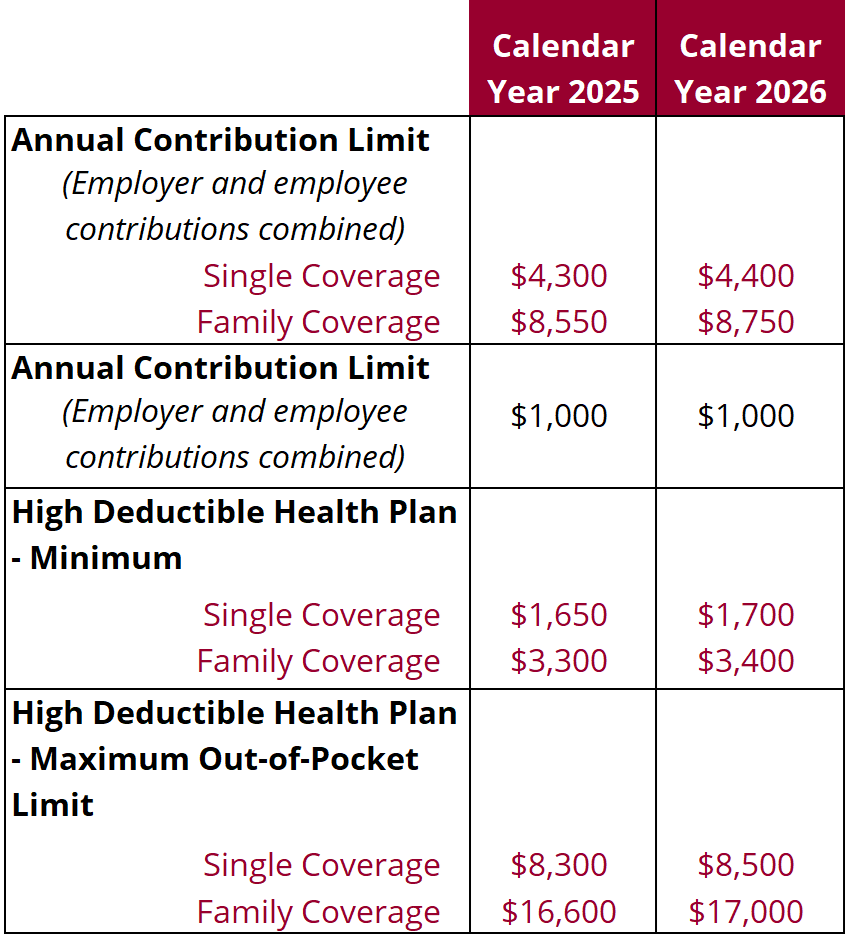
If you have any questions, please reach out to your Relationship Manager at Rose Street Advisors, or email info@rosestreetadvisors.com.
Interested in more?
Let's Talk





 One of the many requirements in the Affordable Care Act (ACA) is the Patient-Centered Outcomes Research Institute (PCORI) fee, an often overlooked but essential aspect of compliance. The PCORI fee is a charge imposed on issuers of specified health insurance policies and plan sponsors of applicable self-insured health plans. It was established to fund the Patient-Centered Outcomes Research Institute, an organization tasked with improving the quality and relevance of evidence available to help patients, caregivers, and healthcare providers make informed health decisions.

 What is a Spousal Incentive Opt-Out HRA Plan?
While many organizations have a taxable cash opt-out or waiver incentive that is offered to employees who are covered by health insurance coverage elsewhere, a spousal incentive opt-out HRA (sometimes called a spousal HRA, etc.) provides an opportunity to offer a larger, tax-free incentive to employees at similar (tax deductible) cost to employers. A spousal incentive opt-out HRA plan is an arrangement where employers offer financial incentives to employees whose spouses have access to health insurance through their own employer and choose to opt-out of the company’s health plan in favor of the spouse’s plan. Instead of covering the family under the company’s plan, the employer provides a tax-free HRA incentive to the employee, which can be used to reimburse eligible medical expenses.
How Does It Work?
Here's a simplified breakdown of how these plans typically work:
1. Eligibility: The employee’s spouse must have access to their own employer-sponsored health plan, and the family must enroll in that coverage after opting out of the company’s plan. The employee must prove this enrollment.
2. Incentive/Usage: The employer provides an HRA as an incentive, which is usually a set amount of money that can be used for qualifying medical expenses, including deductibles, copayments, and other out-of-pocket healthcare costs. The exact amount and the types of eligible expenses are determined by the employer. The HRA funds are tax-free and can be used throughout the year for various medical expenses.
3. Administration: While HRAs can be administered by an employer, they are typically administered by a separate TPA, similar to the work done for Flexible Spending Accounts (FSAs).
Benefits for Employers
1. Cost Savings: Employers save on the premiums they would otherwise pay to cover the spouse under the company plan.
2. Risk Management: By encouraging spouses to use their own employer’s plan to cover the entire family, the overall risk pool for the company’s health plan can become more stable and predictable.
3. Employee Satisfaction: Offering an HRA as an incentive provides a valuable benefit to employees, showing that the company cares about providing flexible and supportive options for their healthcare needs. The HRA also provides a much greater potential benefit to employees vs a traditional, taxable cash incentive.
Benefits for Employees
1. Financial Incentive: Employees receive a financial benefit for opting out of the company plan for their spouse’s coverage, which can help offset the employee’s healthcare costs. As stated above, the financial benefit in an HRA is usually significantly higher than the taxable cash incentive.
2. Flexibility: The HRA funds can be used for a wide range of medical expenses, as determined by the employer, offering flexibility and financial support.
3. Simplified Coverage: For some families, having all family members on the same health plan can simplify coverage and coordination of benefits.
Considerations
While spousal incentive opt-out HRA plans offer numerous benefits, there are a few things to consider:
• Spousal Carveout or Surcharge: Spousal incentive opt-out HRAs are often paired with programs that either exclude a spouse’s enrollment in the company’s health plan if they have coverage available to them at their employer (carveout) or may simply add a surcharge to employees who cover their spouse on the company’s health plan when they have coverage available to them at their employer.
• Eligibility: An employer may limit the availability of the HRA incentive to those with spousal coverage available vs a parent’s coverage available.
• Group Health Plan Integration: It is imperative that the spouse has comprehensive health coverage available to entire family, and that the family enrolls in that coverage. The HRA must be integrated with the spouse’s group health plan to avoid healthcare reform issues.
• Health Savings Accounts (HSAs): In order for someone to contribute to or receive contributions to an HSA, they must not be enrolled in any non-high deductible health plan (HDHP) coverage. A spousal incentive opt-out HRA would constitute a non-HDHP coverage. Therefore, if an employee accepts the HRA incentive, the spouse could NOT contribute to an HSA. For some people, the HRA may offset the lack of an HSA. For others, they may wish to continue to fund their HSA and may wish to either forgo the HRA incentive OR you can offer a lower, taxable cash opt-out incentive alongside the HRA incentive OR offer as a limited purpose HRA for dental and vision expenses only.
• COBRA Continuation: The spousal incentive opt-out HRA is a COBRA qualified benefit. This means that employees could elect to continue their HRA after a COBRA qualifying event.
• Communication: Clear communication with employees about how the HRA works, the rules above and what expenses are eligible is crucial.
• Compliance: The design of the spousal incentive opt-out HRA must maintain compliance with the ACA, HIPAA nondiscrimination rules, §125 nondiscrimination rules, Medicare Secondary Payer (MSP) rules, etc.
Conclusion
Spousal incentive opt-out HRA plans can be a win-win for both employers and employees, offering cost savings, flexibility, and valuable benefits. By understanding how these plans work and implementing them thoughtfully, companies can enhance their benefits offerings and support their employees' diverse needs.
Is your company ready to explore the potential of spousal incentive opt-out HRA plans? Reach out to your Rose Street Advisors’ Relationship Manager or contact us at
What is a Spousal Incentive Opt-Out HRA Plan?
While many organizations have a taxable cash opt-out or waiver incentive that is offered to employees who are covered by health insurance coverage elsewhere, a spousal incentive opt-out HRA (sometimes called a spousal HRA, etc.) provides an opportunity to offer a larger, tax-free incentive to employees at similar (tax deductible) cost to employers. A spousal incentive opt-out HRA plan is an arrangement where employers offer financial incentives to employees whose spouses have access to health insurance through their own employer and choose to opt-out of the company’s health plan in favor of the spouse’s plan. Instead of covering the family under the company’s plan, the employer provides a tax-free HRA incentive to the employee, which can be used to reimburse eligible medical expenses.
How Does It Work?
Here's a simplified breakdown of how these plans typically work:
1. Eligibility: The employee’s spouse must have access to their own employer-sponsored health plan, and the family must enroll in that coverage after opting out of the company’s plan. The employee must prove this enrollment.
2. Incentive/Usage: The employer provides an HRA as an incentive, which is usually a set amount of money that can be used for qualifying medical expenses, including deductibles, copayments, and other out-of-pocket healthcare costs. The exact amount and the types of eligible expenses are determined by the employer. The HRA funds are tax-free and can be used throughout the year for various medical expenses.
3. Administration: While HRAs can be administered by an employer, they are typically administered by a separate TPA, similar to the work done for Flexible Spending Accounts (FSAs).
Benefits for Employers
1. Cost Savings: Employers save on the premiums they would otherwise pay to cover the spouse under the company plan.
2. Risk Management: By encouraging spouses to use their own employer’s plan to cover the entire family, the overall risk pool for the company’s health plan can become more stable and predictable.
3. Employee Satisfaction: Offering an HRA as an incentive provides a valuable benefit to employees, showing that the company cares about providing flexible and supportive options for their healthcare needs. The HRA also provides a much greater potential benefit to employees vs a traditional, taxable cash incentive.
Benefits for Employees
1. Financial Incentive: Employees receive a financial benefit for opting out of the company plan for their spouse’s coverage, which can help offset the employee’s healthcare costs. As stated above, the financial benefit in an HRA is usually significantly higher than the taxable cash incentive.
2. Flexibility: The HRA funds can be used for a wide range of medical expenses, as determined by the employer, offering flexibility and financial support.
3. Simplified Coverage: For some families, having all family members on the same health plan can simplify coverage and coordination of benefits.
Considerations
While spousal incentive opt-out HRA plans offer numerous benefits, there are a few things to consider:
• Spousal Carveout or Surcharge: Spousal incentive opt-out HRAs are often paired with programs that either exclude a spouse’s enrollment in the company’s health plan if they have coverage available to them at their employer (carveout) or may simply add a surcharge to employees who cover their spouse on the company’s health plan when they have coverage available to them at their employer.
• Eligibility: An employer may limit the availability of the HRA incentive to those with spousal coverage available vs a parent’s coverage available.
• Group Health Plan Integration: It is imperative that the spouse has comprehensive health coverage available to entire family, and that the family enrolls in that coverage. The HRA must be integrated with the spouse’s group health plan to avoid healthcare reform issues.
• Health Savings Accounts (HSAs): In order for someone to contribute to or receive contributions to an HSA, they must not be enrolled in any non-high deductible health plan (HDHP) coverage. A spousal incentive opt-out HRA would constitute a non-HDHP coverage. Therefore, if an employee accepts the HRA incentive, the spouse could NOT contribute to an HSA. For some people, the HRA may offset the lack of an HSA. For others, they may wish to continue to fund their HSA and may wish to either forgo the HRA incentive OR you can offer a lower, taxable cash opt-out incentive alongside the HRA incentive OR offer as a limited purpose HRA for dental and vision expenses only.
• COBRA Continuation: The spousal incentive opt-out HRA is a COBRA qualified benefit. This means that employees could elect to continue their HRA after a COBRA qualifying event.
• Communication: Clear communication with employees about how the HRA works, the rules above and what expenses are eligible is crucial.
• Compliance: The design of the spousal incentive opt-out HRA must maintain compliance with the ACA, HIPAA nondiscrimination rules, §125 nondiscrimination rules, Medicare Secondary Payer (MSP) rules, etc.
Conclusion
Spousal incentive opt-out HRA plans can be a win-win for both employers and employees, offering cost savings, flexibility, and valuable benefits. By understanding how these plans work and implementing them thoughtfully, companies can enhance their benefits offerings and support their employees' diverse needs.
Is your company ready to explore the potential of spousal incentive opt-out HRA plans? Reach out to your Rose Street Advisors’ Relationship Manager or contact us at 
 In today’s dynamic employment landscape, staying compliant with healthcare regulations is crucial for employers. The Affordable Care Act (ACA), signed into law in 2010, brought significant changes to the healthcare system, including requirements for employers to offer health insurance to eligible employees. As an Applicable Large Employer (ALE) under the ACA certain responsibilities and compliance requirements now apply to your organization. Here’s what you need to know and steps you can take to navigator ACA compliance effectively:
Understanding ALE Status
1. Definition of ALE: An ALE is an employer with 50 or more full-time equivalent employees (FTEs) during the previous calendar year. Full-time employees are those who work, on average, at least 30 hours per week or 130 hours per month.
2. Determining FTE Count: Calculate your FTE count by combining the total hours worked by all employees (including part-time employees) in a month and dividing by 120. This will help determine if you meet the threshold for ALE status.
ACA Compliance Steps for ALEs:
1. Offering Minimum Essential Coverage (MEC):
• ALEs must offer Minimum Essential Coverage to at least 95% of full-time employees and their dependents to avoid potential penalties.
• The coverage offered must meet affordability and minimum value standards set by the ACA.
2. Employer Shared Responsibility (ESR) Provision:
• Ensure compliance with the ESR provision, also known as the “employer mandate”, which requires ALEs to offer affordable health insurance that provides minimum value to eligible employees.
• Track and monitor employee hours to determine full-time status and eligibility for coverage.
3. Reporting Requirements:
• File Forms 1094-C and 1085-C annually with the IRS.
• These forms provide detailed information about the health insurance coverage offered to full-time employees and are used to assess compliance with the ACA employer mandate.
• Stay up to date about ACA Reporting deadlines. Typically, these occur early in the years (i.e. January 31st for distributing Form 1095-C to employees and February 28th/March 31st for filing forms with the IRS)
Tips for Ensuring ACA Compliance:
1. Consult With Experts: Consider seeking guidance from your RSA Team and/or legal advisors to ensure accurate interpretation and implementation of ACA regulations.
2. Invest in HR Technology: Implement robust HR and payroll systems that can accurately track employee hours, manage benefits enrollment, and generate required ACA reports.
• IMPORTANT - Don't forget to ask your RSA Team how Employee Navigator can help you.
3. Educate Employees: Provide clear and transparent communication to employees about their health insurance options, enrollment process, and rights under the ACA.
4. Stay Updated: Regularly monitor updates and changes to the ACA regulations issued by the IRS and other governing bodies to stay compliant with evolving requirements.
Becoming an ALE signifies growth and success for your organization but also brings added responsibilities in terms of ACA compliance. By understanding your obligations, taking proactive steps, and leveraging available resources, you can navigate ACA compliance effectively while supporting the well-being of your workforce.
If you have any questions or need further assistance with ACA compliance, please contact your Relationship Manager to discuss your needs in greater detail. If your are not a current client of Rose Street Advisors, please feel free to contact us at 269-552-3200 or
In today’s dynamic employment landscape, staying compliant with healthcare regulations is crucial for employers. The Affordable Care Act (ACA), signed into law in 2010, brought significant changes to the healthcare system, including requirements for employers to offer health insurance to eligible employees. As an Applicable Large Employer (ALE) under the ACA certain responsibilities and compliance requirements now apply to your organization. Here’s what you need to know and steps you can take to navigator ACA compliance effectively:
Understanding ALE Status
1. Definition of ALE: An ALE is an employer with 50 or more full-time equivalent employees (FTEs) during the previous calendar year. Full-time employees are those who work, on average, at least 30 hours per week or 130 hours per month.
2. Determining FTE Count: Calculate your FTE count by combining the total hours worked by all employees (including part-time employees) in a month and dividing by 120. This will help determine if you meet the threshold for ALE status.
ACA Compliance Steps for ALEs:
1. Offering Minimum Essential Coverage (MEC):
• ALEs must offer Minimum Essential Coverage to at least 95% of full-time employees and their dependents to avoid potential penalties.
• The coverage offered must meet affordability and minimum value standards set by the ACA.
2. Employer Shared Responsibility (ESR) Provision:
• Ensure compliance with the ESR provision, also known as the “employer mandate”, which requires ALEs to offer affordable health insurance that provides minimum value to eligible employees.
• Track and monitor employee hours to determine full-time status and eligibility for coverage.
3. Reporting Requirements:
• File Forms 1094-C and 1085-C annually with the IRS.
• These forms provide detailed information about the health insurance coverage offered to full-time employees and are used to assess compliance with the ACA employer mandate.
• Stay up to date about ACA Reporting deadlines. Typically, these occur early in the years (i.e. January 31st for distributing Form 1095-C to employees and February 28th/March 31st for filing forms with the IRS)
Tips for Ensuring ACA Compliance:
1. Consult With Experts: Consider seeking guidance from your RSA Team and/or legal advisors to ensure accurate interpretation and implementation of ACA regulations.
2. Invest in HR Technology: Implement robust HR and payroll systems that can accurately track employee hours, manage benefits enrollment, and generate required ACA reports.
• IMPORTANT - Don't forget to ask your RSA Team how Employee Navigator can help you.
3. Educate Employees: Provide clear and transparent communication to employees about their health insurance options, enrollment process, and rights under the ACA.
4. Stay Updated: Regularly monitor updates and changes to the ACA regulations issued by the IRS and other governing bodies to stay compliant with evolving requirements.
Becoming an ALE signifies growth and success for your organization but also brings added responsibilities in terms of ACA compliance. By understanding your obligations, taking proactive steps, and leveraging available resources, you can navigate ACA compliance effectively while supporting the well-being of your workforce.
If you have any questions or need further assistance with ACA compliance, please contact your Relationship Manager to discuss your needs in greater detail. If your are not a current client of Rose Street Advisors, please feel free to contact us at 269-552-3200 or  Employee benefits are a critical component of talent retention, and providing clear information about these benefits is a legal requirement for employers. The Summary Plan Description (SPD) serves as a crucial document in this communication process. In 2024, the landscape is evolving, with an increased focus on compliance through audits. In this blog post, we will explore the top reasons you need (and want) an SPD and the essential requirements for creating an effective and compliant SPD.
 In today’s benefits advisor blog, we’ll briefly touch on the types of virtual health care and how each of the primary health insurance carriers in SW Michigan are providing solutions.
Virtual health care is primarily provided via internet video visits (and phone to a lesser extent) with health care professionals. The care can be provided by your personal physician or physician’s office, more like a traditional office visit, just virtually vs. in-person. It can also be provided through your health insurance carrier or a separate third party.
Virtual health care can be used to treat non-emergency physical issues such as allergies, bites and stings, fever, headache, sore throats, colds, cough and flu, as well as various infections such as eye, ear, pink eye, etc.
More recently, virtual health care can also be used for behavioral, mental health and substance abuse issues such as anxiety, depression, addiction and chronic or acute issues that occur.
Many of our employee benefits clients in the Kalamazoo and SW Michigan area use BCBS/BCN, Priority Health or United Healthcare as their insurance carriers. Below is a little information about the virtual health care solutions from each. If your health plan is with a different medical carrier or is self-funded, please be sure to ask about the availability and details of virtual health care with your employer.
BCBS/BCN: BCBS (PPO) and BCN (HMO and POS) partnered with Teladoc effective January 1, 2024. More information here:
In today’s benefits advisor blog, we’ll briefly touch on the types of virtual health care and how each of the primary health insurance carriers in SW Michigan are providing solutions.
Virtual health care is primarily provided via internet video visits (and phone to a lesser extent) with health care professionals. The care can be provided by your personal physician or physician’s office, more like a traditional office visit, just virtually vs. in-person. It can also be provided through your health insurance carrier or a separate third party.
Virtual health care can be used to treat non-emergency physical issues such as allergies, bites and stings, fever, headache, sore throats, colds, cough and flu, as well as various infections such as eye, ear, pink eye, etc.
More recently, virtual health care can also be used for behavioral, mental health and substance abuse issues such as anxiety, depression, addiction and chronic or acute issues that occur.
Many of our employee benefits clients in the Kalamazoo and SW Michigan area use BCBS/BCN, Priority Health or United Healthcare as their insurance carriers. Below is a little information about the virtual health care solutions from each. If your health plan is with a different medical carrier or is self-funded, please be sure to ask about the availability and details of virtual health care with your employer.
BCBS/BCN: BCBS (PPO) and BCN (HMO and POS) partnered with Teladoc effective January 1, 2024. More information here: