Rose Street Advisors Rose Street Advisors
Firm
About UsOur TeamM Financial GroupEducation LibraryCommunity SupportTestimonials
Benefits
Employee Benefit ServicesBenefits FAQBenefits University Blog
HR Consulting
HR Consulting ServicesHR BlogRose Street Recruits
Life Insurance
Life Insurance ServicesLife Happens BlogLife Insurance Vlog
Employer Retirement Plans
Retirement ServicesFiduciary Fitness ProgramGuide to Retirement BlogRetirement Plans FAQ
Wealth Management
Wealth Management ServicesInvestED BlogWealth Management FAQs
Get In Touch
Firm
About UsOur TeamM Financial GroupEducation LibraryCommunity SupportTestimonials
Benefits
Employee Benefit ServicesBenefits FAQBenefits University Blog
HR Consulting
HR Consulting ServicesHR BlogRose Street Recruits
Life Insurance
Life Insurance ServicesLife Happens BlogLife Insurance Vlog
Employer Retirement Plans
Retirement ServicesFiduciary Fitness ProgramGuide to Retirement BlogRetirement Plans FAQ
Wealth Management
Wealth Management ServicesInvestED BlogWealth Management FAQs
Get In Touch

When most of us think about retirement planning, we think about contributing to our 401(k) or 403(b), choosing the right investment mix, and figuring out when to start Social Security. Healthcare costs often get left out of the conversation entirely, or treated as an afterthought. That's worth fixing. For many retirees, healthcare ends up being one of the largest expenses they'll face, and it's also one of the most misunderstood. The good news: a little planning now can save you a lot of stress later, and you don't need to be a healthcare expert to get started.

Why Healthcare Costs Deserve Their Own Plan


Healthcare in retirement isn't just "whatever Medicare covers." Premiums, deductibles, copays, dental and vision care, and the possibility of long-term care can add up to a substantial portion of your retirement budget. Costs also tend to rise faster than general inflation, which means the number you have in mind today may not be the number you'll actually need.

To put a real number on it: Fidelity's most recent Retiree Health Care Cost Estimate found that a 65-year-old retiring today should expect to spend roughly $172,500 on healthcare over the course of retirement, or about $345,000 for a couple, and that figure doesn't even include long-term care. For context, that estimate has more than doubled since Fidelity began tracking it in 2002, when it stood at around $80,000. It's a big number, but the point isn't to alarm you, it's to make the planning feel concrete rather than abstract.

The goal isn't to scare you. It's to help you build healthcare into your overall retirement plan the same way you'd plan for housing or travel, so it doesn't catch you off guard.

Medicare 101: The Basics You Need


Medicare is the foundation of healthcare coverage for most people starting at age 65, but it doesn't cover everything, and timing matters.

Part A (hospital insurance) is usually premium-free if you or your spouse paid Medicare taxes for at least 10 years. It covers inpatient hospital stays, skilled nursing facility care, and some home health care.

Part B (medical insurance) covers doctor visits, outpatient care, and preventive services, but it comes with a monthly premium. For 2026, the standard Part B premium is $202.90 per month, with an annual deductible of $283. Higher earners pay more through something called IRMAA (Income-Related Monthly Adjustment Amount), which is based on your tax return from two years prior; in 2026, the surcharge kicks in once income exceeds $109,000 for single filers or $218,000 for joint filers, and total monthly Part B premiums for higher earners can range from roughly $284 up to $690, depending on income. This is worth knowing if you're planning a high-income year close to retirement, such as a large Roth conversion, since the income from that year can bump up your premiums two years down the road.

Part C (Medicare Advantage) is an alternative to traditional Medicare offered through private insurers, often bundling in extra benefits like dental or vision.

Part D (prescription drug coverage) helps with medication costs and, like Part B, can carry an income-based surcharge.

One detail that trips people up: if you're still working past 65 and have employer coverage, you may be able to delay enrolling in Medicare without penalty, but only under certain conditions. If you miss your enrollment window without qualifying coverage, you could face permanent late-enrollment penalties. If you're approaching 65, it's worth checking your specific situation well before your birthday.

The Gap Years: Retiring Before 65


If you're hoping to retire before age 65, healthcare is one of the biggest financial puzzles to solve, since Medicare eligibility doesn't start until then. Options typically include COBRA continuation coverage, a marketplace plan, a spouse's employer plan, or in some cases retiree coverage offered by your employer. Each comes with different costs and trade-offs, so it's worth mapping this out years in advance rather than scrambling as your retirement date approaches.

Don't Overlook the HSA


If you have access to a Health Savings Account through a high-deductible health plan, it may be one of the most powerful tools available to you for retirement healthcare planning. HSAs offer a rare triple tax advantage: contributions are tax-deductible, growth is tax-free, and withdrawals for qualified medical expenses are tax-free too. Unlike a Flexible Spending Account, HSA balances roll over year to year and stay with you even after you change jobs or retire.

Many people use their HSA as a pass-through account, contributing and then immediately spending on current medical costs. But if your budget allows, consider paying current medical expenses out of pocket and letting your HSA balance grow. Over time, it can become a dedicated fund for healthcare costs in retirement, including Medicare premiums (though not supplemental Medigap premiums).

The Long-Term Care Question


Long-term care, whether that's an in-home aide, assisted living, or a nursing facility, is one of the most expensive and least planned-for parts of retirement. Here's an important distinction: Medicare generally does not cover long-term custodial care. It covers short-term skilled nursing after a hospital stay, but not the ongoing help with daily activities that many people eventually need.

There's no one-size-fits-all answer for how to prepare. Some people choose long-term care insurance, which can be expensive and varies widely in coverage. Others self-insure by setting aside dedicated savings. Some look at hybrid life insurance or annuity products with long-term care riders. The right approach depends on your health, family history, assets, and how much risk you're comfortable carrying yourself. The earlier you start thinking about it, the more options you'll have, since long-term care insurance becomes harder and more expensive to get as you age or if your health changes.

Practical Steps You Can Take Now


A few things are worth doing regardless of how far away retirement feels:

First, estimate your future healthcare costs realistically rather than guessing. There are online tools and calculators that can give you a ballpark figure based on your age, health, and where you plan to retire.

Second, if you have an HSA, contribute consistently and consider letting it grow rather than spending it down each year.

Third, talk to your benefits team or financial advisor about how your specific retirement plan, pension, or employer benefits interact with Medicare. Some employers offer retiree health benefits or Medicare supplement subsidies that can change your math significantly.

Fourth, build a rough long-term care plan, even a simple one. Knowing your general approach, whether that's insurance, savings, or family support, removes a lot of uncertainty.

Finally, revisit your plan periodically. Healthcare policy, your income, and your health all change over time, so this isn't a one-and-done exercise.

The Bottom Line


Healthcare costs in retirement are significant, but they're also plannable. You don't need to have every detail figured out today, and you certainly don't need to become a Medicare expert overnight. What matters is starting the conversation early, understanding the basic building blocks like Medicare and HSAs, and thinking honestly about long-term care before you're in a position where you need it urgently.

If you're not sure where to start, that's completely normal, and it's exactly what your retirement plan's resources are there for. Take a look at the educational tools available through your plan, sit in on a benefits webinar if one's offered, or reach out to schedule time with a plan advisor to talk through your specific situation. A short conversation now can make a real difference in how prepared you feel later.

Scott Higgins | AIF ®, CFP®, CPFA®, NSSA®

Financial Advisor

Securities and Investment Advisory Services Offered Through M Holdings Securities, Inc., a Registered Broker/Dealer and Investment Adviser, Member FINRA/SIPC. Rose Street Advisors is independently owned and operated. #5795956

Interested in more?

Let's Talk Proactive HR

As a Benefits Advisor, I’ve seen a noticeable uptick in members receiving letters from their health insurance plans about hospital contract negotiations. These notices often arrive with urgent-sounding language and can trigger unnecessary panic. The good news? Most of these communications are routine, required by regulations, and do not mean you’re losing coverage or facing immediate changes.

This FAQ explains the basics in plain language so you can feel more confident navigating the process.

What are hospital contract negotiations?

Health insurance companies (payers) and hospitals (providers) negotiate contracts that determine how much the insurer pays the hospital for services and what members pay out-of-pocket (copays, coinsurance, deductibles). These agreements cover rates, covered services, network participation, and administrative rules.

Contracts typically last 1–3 years (sometimes longer). When they near expiration, the parties renegotiate. If they don’t reach a new agreement quickly, the hospital may temporarily go “out-of-network” with that insurer until a deal is finalized.

Why am I suddenly getting notices about this?

State and federal regulations often require insurers to notify members in advance of potential network changes. These notices must be sent within specific timeframes (e.g., 30–60 days before a contract expires or a change takes effect). Insurers send them proactively—even while negotiations are ongoing—to comply with the law.

The tone can sound alarming because regulators want members to have time to make informed decisions. In reality, the vast majority of negotiations resolve successfully, and the hospital stays in-network with little or no disruption for members.

Does a negotiation notice mean my hospital will no longer be covered?

Not necessarily. Many contracts are renewed or extended while talks continue. A notice is often a “just in case” communication.

  • In-network status means lower out-of-pocket costs for you.
  • If a hospital does go out-of-network temporarily, your plan usually has contingency protections (e.g., continued coverage at in-network rates for ongoing treatments, or “hold harmless” provisions that prevent balance billing for certain services).

Always check your plan’s Explanation of Benefits (EOB) or member portal for the most current network status rather than relying solely on the notice.

What should I do if I receive one of these notices?

  1. Stay calm and read carefully — Note the effective dates and any specific services or hospitals mentioned.
  2. Verify network status — Log into your insurer’s website or app, or call the member services number on your insurance card. Search for your preferred hospital or doctors.
  3. Review alternatives — Most plans have multiple in-network hospitals. Ask about other facilities in your area.
  4. Contact your Benefits Advisor or HR — We can help interpret the notice, check for updates, and explore options.
  5. Don’t delay necessary care — If you have an upcoming procedure, contact your doctor’s office and the insurer to confirm coverage details.

Will my premiums or out-of-pocket costs go up because of these negotiations?

Rate changes are more often driven by overall medical inflation, plan design, and utilization trends—not a single hospital negotiation. If a hospital’s rates increase significantly, it can contribute to future premium pressure, but insurers work to balance costs across their entire network. Many plans include tools like price transparency, reference-based pricing, or centers of excellence to help control costs.

What happens if a hospital actually goes out-of-network?

  • Emergency care: Usually covered at in-network rates regardless of network status (by law in most cases).
  • Ongoing treatment: Plans may allow continuity of care for active courses of treatment (chemotherapy, surgery recovery, pregnancy, etc.).
  • Balance billing: Many states protect consumers from surprise bills where the hospital charges you the difference between their full rate and what insurance pays.
  • Transition period: Insurers frequently negotiate short-term extensions or “bridge” agreements to minimize disruption.

How common are these negotiation-related disruptions?

They are relatively common but rarely result in long-term network drops. Major health systems and large insurers negotiate frequently, and the public nature of some high-profile disputes can make it seem more chaotic than it is for the average member. Most reach agreements before major impacts occur.

Tips for managing your health coverage proactively

  • Use your insurer’s provider directory regularly (it updates more frequently than annual notices).
  • Build relationships with your primary care provider—they can help navigate specialists and facilities.
  • Consider a Health Savings Account (HSA) or Flexible Spending Account (FSA) if eligible, to buffer against potential cost-sharing.
  • Ask questions early: Open enrollment is a great time to review network adequacy.

Final thoughts

Contract negotiations are a normal part of the health insurance ecosystem. The notices you receive are designed to inform you, not alarm you. By understanding the process, you can focus on what matters most—getting the care you need without unnecessary stress.

If you’ve received a notice and would like help reviewing it, checking network options, or exploring plan alternatives, reach out to me directly. As your benefits broker, I’m here to advocate for you and cut through the noise.

Have questions about your specific plan or a notice you received? Drop a comment below or contact our office. We’re happy to help provide clarity tailored to your situation.

Disclaimer: This post is for educational purposes and is not a substitute for personalized advice. Always verify details with your insurance carrier and consult professionals for your individual circumstances. Information reflects general U.S. practices as of 2026 and can vary by state and plan.

Let's Talk

Interested in more?

Let's Talk Proactive HR

New Benefits, Big Changes: What the OBBBA Means for HDHPs Telehealth, FSAs, HSAs & More

The recently passed One Big Beautiful Bill Act (OBBBA) brings a wave of important updates that will directly impact health plan administration, tax-preferred accounts, and telehealth accessibility, many of which take effect starting January 1, 2026. Thanks to the advocacy efforts of associations that RSA is a part of, several long-supported reforms have become law. Below, we break down what's changing and what to watch for in the future. 

HDHPs and Telehealth Visits

RSA-Supported Legislation

• Current Policy: Telehealth visits under High Deductible Health Plans (HDHPs) apply to the deductible, and only after the deductible is met do copayments and coinsurance kick in. 

• What's Changing: Retroactive to plan years beginning January 1, 2024, telehealth benefits through a HDHP allow for $0 copay before the deductible is met.


Important Caveat: Carrier discretion towards $0 copays will apply.

Direct Primary Care (DPC) and HSAs

RSA-Supported Legislation

• Current Policy: Payments for Direct Primary Care arrangements disqualify an individual from HSA contributions.

• What's Changing: DPC subscriptions will qualify as HSA-eligible expenses, up to $150/month for individuals and $300/month for families (adjusted annually for inflation). This unlocks tax-advantaged access to a growing model of patient-centered care. This takes place effective January 1, 2026. 

Dependent Care FSA Limits

• Current Policy: Employees can contribute up to $5,000/year pre-tax (or $2,500/year if married filing separately) to a Dependent Care Flexible Spending Account (FSA).

• What's Changing: Effective January 1, 2026, employers may choose to adopt the new IRS maximum of $7,500/year (or $3,750/year if married filing separately).


Note: This new limit is not indexed for inflation.

Bronze & Catastrophic Exchange Plans and HSA Eligibility

• Current Policy: Exchange plans must comply with standard HDHP rules to be HSA-eligible.

• What's Changing: Starting in 2026, all Bronze and Catastrophic plans sold on the Exchange will automatically qualify as HDHPs, regardless of whether they meet existing deductible or cost-sharing thresholds.

Eligibility Criteria: 

- Enrolled in a qualifying Exchange plan

- Not enrolled in Medicare Part A

- No disqualifying coverage

- Not claimed as a dependent on another's current-year tax return 

Tax-Free Student Loan Repayments

• Current Policy: Under the CARES Act, employer-sponsored student loan repayment assistance was temporarily tax-free and set to expire in 2025.

• What's Changing: The benefit is now permanently codified under Section 127 Education Assistance Plan. Employers can contribute up to $5,250 per year, tax-free, toward an employee’s student loans.


Note: Requires a formal plan document and must meet nondiscrimination rules.

While the OBBBA included several impactful benefit enhancements, it's equally important to understand the provisions that were discussed during the legislative process and ultimately excluded from the final legislation. These items remain significant areas of interest for many employers, benefits professionals, and policymakers. 

• Extension of Enhanced Premium Tax Credits for the individual market, which are set to expire at the end of 2025

• Codification of Individual Coverage Health Reimbursement Accounts (ICHRAs)

• HSA Expansion to wearable technology and working seniors

Employer Takeaways

• Plan Ahead and engage your benefits consultant about 2026 plan strategy and updates.

• Educate employees about new HSA flexibility, DPC options, and benefit expansions.

• Review & update plan documents and administrative procedures.

Justine Dickens

EMPLOYEE BENEFITS ADVISOR

Justine is a devoted and meticulous team member with a passion to educate and support business partners and their employees. Since 2013, Justine’s commitment to her clients has allowed her to instill confidence and stability in the benefits packages offered to their employees. Her strengths allow her to communicate efficiently, focus on customization and understand the complexities of an ever changing industry. She is a Dale Carnegie Graduate and has her NAHU Self-Funded Certification.

When she is not working, Justine is busy running her son and daughter to their practices and games and volunteering in the community. She enjoys playing golf, hiking and spending time with her family and friends.

Securities and Investment Advisory Services Offered Through M Holdings Securities, Inc., a Registered Broker/Dealer and Investment Adviser, Member FINRA/SIPC. Rose Street Advisors is independently owned and operated. #4515345

Health Savings Account (HSA) FAQs: Everything You Need to Know

A Health Savings Account (HSA) is a powerful tool that helps individuals save for medical expenses while enjoying tax advantages. If you're considering opening an HSA or want to maximize its benefits, here are some of the most frequently asked questions to guide you. 

1. What is an HSA?

An HSA is a tax-advantaged savings account designed for individuals with a high-deductible health plan (HDHP). The funds in the account can be used for qualified medical expenses, and contributions, earnings and withdrawals for medical purposed are tax-free. 

2. Who is eligible to open an HSA?

To qualify for an HSA, you must: 

• Be enrolled in an HDHP

• Not be covered by any other non-HDHP insurance (except certain exceptions like dental and vision plans) 

• Not be enrolled in Medicare 

• Not be claimed as a dependent on someone else's tax return 

3. What are the contribution limits for an HSA?

• Individuals: $4,300

• Families: $8,550

• Catch-up contribution (for those 55 and older): An additional $1,000

4. What expenses are covered under an HSA?

• Doctor visits and hospital stays 

• Prescription medications 

• Dental and vision care 

• Medical equipment 

• Mental health services 

5. What happens if I use HSA funds for non-medical expenses?

If you withdraw HSA funds for non-qualified expenses before age 65, you'll incur a 20% penalty plus income tax. After age 65, non-medical withdrawals are subject to income tax but no penalty. 

6. Can HSA funds be invested?

Yes, many HSA providers allow you to invest your funds in stocks, bonds, or mutual funds to grow your savings tax-free. 

7. What happens to my HSA if I switch jobs or retire?

HSAs are portable, meaning they stay with you even if you change jobs or retire. Once you turn 65, you can use HSA funds for any purpose without penalties, through non-medical expenses will be taxed as regular income. 

8. Can I have both an HSA and an FSA?

Typically, you cannot contribute to both a Health Savings Account (HSA) and a Flexible Spending Account (FSA) simultaneously, except for a limited-purpose FSA (used for dental and vision expenses only). Of course, because Dependent Care FSAs aren't connected to medical expenses, they are not impacted by HSA contributions.  

9. Do HSA funds expire?

No, HSA funds roll over year to year. Unlike FSAs, there is no "use it or lose it" rule, so your savings can grow over time. 

10. How do I open an HSA?

You can open an HSA through a bank, credit union, insurance company, or other financial institutions. Many employers also offer HSAs as part of their benefits packages. 

Final Thoughts

An HSA can be an excellent way to save for medical expenses while benefiting from tax advantages. Understanding the eligibility requirements, contribution limits, and investment options can help you make the most of your HSA. 

Still have questions? Contact your Rose Street Advisors team to see if an HSA is right for you! If you are not a current client of Rose Street Advisors, please feel free to contact us at 269-552-3200 or contact@rosestreetadvisors.com to speak to someone

Justine Dickens

EMPLOYEE BENEFITS ADVISOR

Justine is a devoted and meticulous team member with a passion to educate and support business partners and their employees. Since 2013, Justine’s commitment to her clients has allowed her to instill confidence and stability in the benefits packages offered to their employees. Her strengths allow her to communicate efficiently, focus on customization and understand the complexities of an ever changing industry. She is a Dale Carnegie Graduate and has her NAHU Self-Funded Certification.

When she is not working, Justine is busy running her son and daughter to their practices and games and volunteering in the community. She enjoys playing golf, hiking and spending time with her family and friends.

Securities and Investment Advisory Services Offered Through M Holdings Securities, Inc., a Registered Broker/Dealer and Investment Adviser, Member FINRA/SIPC. Rose Street Advisors is independently owned and operated. #4515345

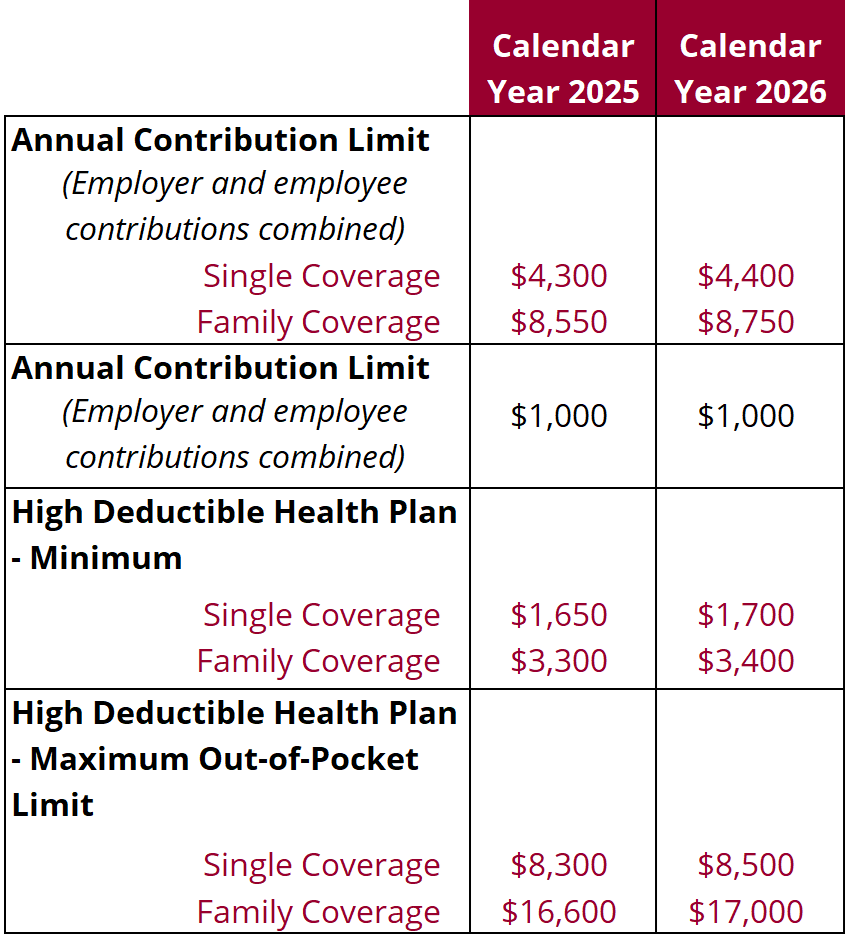
The IRS has released the updated inflation-adjusted limits for health savings accounts (HSAs) and high deductible health plans (HDHPs) for 2026. Annual contribution limits, minimum deductibles for HDHPs, and maximum out-of-pocket expenses will see an increase. However, the additional catch-up contribution limit for individuals aged 55 and older will remain unchanged.

If you have any questions, please reach out to your Relationship Manager at Rose Street Advisors, or email info@rosestreetadvisors.com.

Interested in more?

Let's Talk Proactive HR
Rose Street Advisors

Your guide from hire to retire. Rose Street Advisors provides the strategy companies need to grow with confidence.

Firm
About UsOur TeamCommunity SupportTestimonials
Services
Employee BenefitsHR ConsultingLife InsuranceEmployer Retirement PlansWealth ManagementFiduciary Fitness
Contact

244 North Rose Street
Kalamazoo, MI 49007

5181 Plainfield Ave NE
Grand Rapids, MI 49525

269.552.3200
© 2026 Rose Street Advisors LLC. All rights reserved.
Securities and Investment Advisory Services Offered Through M Holdings Securities, Inc. A Registered Broker/Dealer and Investment Advisor, Member FINRA/SIPC. Rose Street Advisors is independently owned and operated. Please go to www.mfin.com/DisclosureStatement for further details regarding this relationship. Check the background of this Firm and/or investment professional on FINRA's BrokerCheck. For important information related to M Securities, refer to the M Securities' Client Relationship Summary (Form CRS) by navigating to mfin.com/m-securities. Registered Representatives are registered to conduct securities business and licensed to conduct insurance business in limited states. Response to, or contact with, residents of other states will only be made upon compliance with applicable licensing and registration requirements. The information in this website is for U.S. residents only and does not constitute an offer to sell, or a solicitation of an offer to purchase brokerage services to persons outside of the United States. This site is for information purposes and should not be construed as legal or tax advice and is not intended to replace the advice of a qualified attorney, financial or tax advisor or plan provider. CA Insurance License. File #5757992.1

We value your privacy

We use cookies to keep this site reliable, understand how it’s used, and — with your permission — to personalize content. You can accept all, reject non-essential, or choose which categories to allow.

Privacy Policy

Cookie Preferences