

Rose Street Advisors Rose Street Advisors
Firm
About UsOur TeamM Financial GroupEducation LibraryCommunity SupportTestimonials
Benefits
Employee Benefit ServicesBenefits FAQBenefits University Blog
HR Consulting
HR Consulting ServicesHR BlogRose Street Recruits
Life Insurance
Life Insurance ServicesLife Happens BlogLife Insurance Vlog
Employer Retirement Plans
Retirement ServicesFiduciary Fitness ProgramGuide to Retirement BlogRetirement Plans FAQ
Wealth Management
Wealth Management ServicesInvestED BlogWealth Management FAQs
Get In Touch
Firm
About UsOur TeamM Financial GroupEducation LibraryCommunity SupportTestimonials
Benefits
Employee Benefit ServicesBenefits FAQBenefits University Blog
HR Consulting
HR Consulting ServicesHR BlogRose Street Recruits
Life Insurance
Life Insurance ServicesLife Happens BlogLife Insurance Vlog
Employer Retirement Plans
Retirement ServicesFiduciary Fitness ProgramGuide to Retirement BlogRetirement Plans FAQ
Wealth Management
Wealth Management ServicesInvestED BlogWealth Management FAQs
Get In Touch

New Benefits, Big Changes: What the OBBBA Means for HDHPs Telehealth, FSAs, HSAs & More

The recently passed One Big Beautiful Bill Act (OBBBA) brings a wave of important updates that will directly impact health plan administration, tax-preferred accounts, and telehealth accessibility, many of which take effect starting January 1, 2026. Thanks to the advocacy efforts of associations that RSA is a part of, several long-supported reforms have become law. Below, we break down what's changing and what to watch for in the future. 

HDHPs and Telehealth Visits

RSA-Supported Legislation

• Current Policy: Telehealth visits under High Deductible Health Plans (HDHPs) apply to the deductible, and only after the deductible is met do copayments and coinsurance kick in. 

• What's Changing: Retroactive to plan years beginning January 1, 2024, telehealth benefits through a HDHP allow for $0 copay before the deductible is met.


Important Caveat: Carrier discretion towards $0 copays will apply.

Direct Primary Care (DPC) and HSAs

RSA-Supported Legislation

• Current Policy: Payments for Direct Primary Care arrangements disqualify an individual from HSA contributions.

• What's Changing: DPC subscriptions will qualify as HSA-eligible expenses, up to $150/month for individuals and $300/month for families (adjusted annually for inflation). This unlocks tax-advantaged access to a growing model of patient-centered care. This takes place effective January 1, 2026. 

Dependent Care FSA Limits

• Current Policy: Employees can contribute up to $5,000/year pre-tax (or $2,500/year if married filing separately) to a Dependent Care Flexible Spending Account (FSA).

• What's Changing: Effective January 1, 2026, employers may choose to adopt the new IRS maximum of $7,500/year (or $3,750/year if married filing separately).


Note: This new limit is not indexed for inflation.

Bronze & Catastrophic Exchange Plans and HSA Eligibility

• Current Policy: Exchange plans must comply with standard HDHP rules to be HSA-eligible.

• What's Changing: Starting in 2026, all Bronze and Catastrophic plans sold on the Exchange will automatically qualify as HDHPs, regardless of whether they meet existing deductible or cost-sharing thresholds.

Eligibility Criteria: 

- Enrolled in a qualifying Exchange plan

- Not enrolled in Medicare Part A

- No disqualifying coverage

- Not claimed as a dependent on another's current-year tax return 

Tax-Free Student Loan Repayments

• Current Policy: Under the CARES Act, employer-sponsored student loan repayment assistance was temporarily tax-free and set to expire in 2025.

• What's Changing: The benefit is now permanently codified under Section 127 Education Assistance Plan. Employers can contribute up to $5,250 per year, tax-free, toward an employee’s student loans.


Note: Requires a formal plan document and must meet nondiscrimination rules.

While the OBBBA included several impactful benefit enhancements, it's equally important to understand the provisions that were discussed during the legislative process and ultimately excluded from the final legislation. These items remain significant areas of interest for many employers, benefits professionals, and policymakers. 

• Extension of Enhanced Premium Tax Credits for the individual market, which are set to expire at the end of 2025

• Codification of Individual Coverage Health Reimbursement Accounts (ICHRAs)

• HSA Expansion to wearable technology and working seniors

Employer Takeaways

• Plan Ahead and engage your benefits consultant about 2026 plan strategy and updates.

• Educate employees about new HSA flexibility, DPC options, and benefit expansions.

• Review & update plan documents and administrative procedures.

Justine Dickens

EMPLOYEE BENEFITS ADVISOR

Justine is a devoted and meticulous team member with a passion to educate and support business partners and their employees. Since 2013, Justine’s commitment to her clients has allowed her to instill confidence and stability in the benefits packages offered to their employees. Her strengths allow her to communicate efficiently, focus on customization and understand the complexities of an ever changing industry. She is a Dale Carnegie Graduate and has her NAHU Self-Funded Certification.

When she is not working, Justine is busy running her son and daughter to their practices and games and volunteering in the community. She enjoys playing golf, hiking and spending time with her family and friends.

Securities and Investment Advisory Services Offered Through M Holdings Securities, Inc., a Registered Broker/Dealer and Investment Adviser, Member FINRA/SIPC. Rose Street Advisors is independently owned and operated. #4515345

Health Savings Account (HSA) FAQs: Everything You Need to Know

A Health Savings Account (HSA) is a powerful tool that helps individuals save for medical expenses while enjoying tax advantages. If you're considering opening an HSA or want to maximize its benefits, here are some of the most frequently asked questions to guide you. 

1. What is an HSA?

An HSA is a tax-advantaged savings account designed for individuals with a high-deductible health plan (HDHP). The funds in the account can be used for qualified medical expenses, and contributions, earnings and withdrawals for medical purposed are tax-free. 

2. Who is eligible to open an HSA?

To qualify for an HSA, you must: 

• Be enrolled in an HDHP

• Not be covered by any other non-HDHP insurance (except certain exceptions like dental and vision plans) 

• Not be enrolled in Medicare 

• Not be claimed as a dependent on someone else's tax return 

3. What are the contribution limits for an HSA?

• Individuals: $4,300

• Families: $8,550

• Catch-up contribution (for those 55 and older): An additional $1,000

4. What expenses are covered under an HSA?

• Doctor visits and hospital stays 

• Prescription medications 

• Dental and vision care 

• Medical equipment 

• Mental health services 

5. What happens if I use HSA funds for non-medical expenses?

If you withdraw HSA funds for non-qualified expenses before age 65, you'll incur a 20% penalty plus income tax. After age 65, non-medical withdrawals are subject to income tax but no penalty. 

6. Can HSA funds be invested?

Yes, many HSA providers allow you to invest your funds in stocks, bonds, or mutual funds to grow your savings tax-free. 

7. What happens to my HSA if I switch jobs or retire?

HSAs are portable, meaning they stay with you even if you change jobs or retire. Once you turn 65, you can use HSA funds for any purpose without penalties, through non-medical expenses will be taxed as regular income. 

8. Can I have both an HSA and an FSA?

Typically, you cannot contribute to both a Health Savings Account (HSA) and a Flexible Spending Account (FSA) simultaneously, except for a limited-purpose FSA (used for dental and vision expenses only). Of course, because Dependent Care FSAs aren't connected to medical expenses, they are not impacted by HSA contributions.  

9. Do HSA funds expire?

No, HSA funds roll over year to year. Unlike FSAs, there is no "use it or lose it" rule, so your savings can grow over time. 

10. How do I open an HSA?

You can open an HSA through a bank, credit union, insurance company, or other financial institutions. Many employers also offer HSAs as part of their benefits packages. 

Final Thoughts

An HSA can be an excellent way to save for medical expenses while benefiting from tax advantages. Understanding the eligibility requirements, contribution limits, and investment options can help you make the most of your HSA. 

Still have questions? Contact your Rose Street Advisors team to see if an HSA is right for you! If you are not a current client of Rose Street Advisors, please feel free to contact us at 269-552-3200 or contact@rosestreetadvisors.com to speak to someone

Justine Dickens

EMPLOYEE BENEFITS ADVISOR

Justine is a devoted and meticulous team member with a passion to educate and support business partners and their employees. Since 2013, Justine’s commitment to her clients has allowed her to instill confidence and stability in the benefits packages offered to their employees. Her strengths allow her to communicate efficiently, focus on customization and understand the complexities of an ever changing industry. She is a Dale Carnegie Graduate and has her NAHU Self-Funded Certification.

When she is not working, Justine is busy running her son and daughter to their practices and games and volunteering in the community. She enjoys playing golf, hiking and spending time with her family and friends.

Securities and Investment Advisory Services Offered Through M Holdings Securities, Inc., a Registered Broker/Dealer and Investment Adviser, Member FINRA/SIPC. Rose Street Advisors is independently owned and operated. #4515345

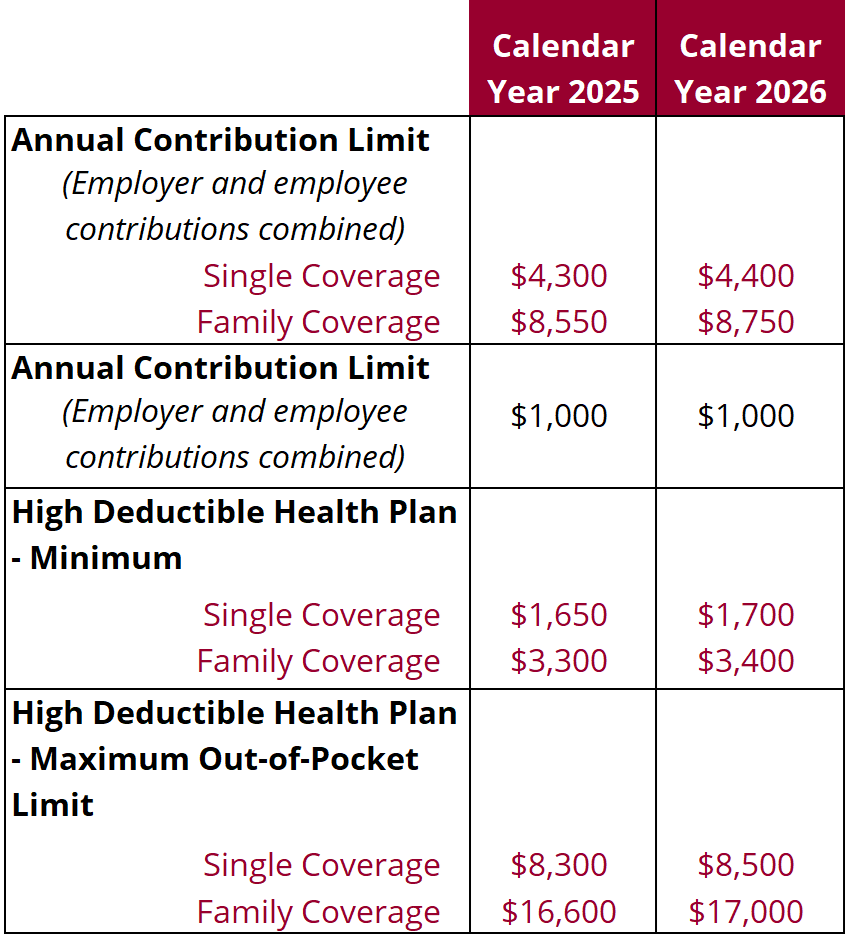
The IRS has released the updated inflation-adjusted limits for health savings accounts (HSAs) and high deductible health plans (HDHPs) for 2026. Annual contribution limits, minimum deductibles for HDHPs, and maximum out-of-pocket expenses will see an increase. However, the additional catch-up contribution limit for individuals aged 55 and older will remain unchanged.

If you have any questions, please reach out to your Relationship Manager at Rose Street Advisors, or email info@rosestreetadvisors.com.

Interested in more?

Let's Talk Proactive HR
Rose Street Advisors

Your guide from hire to retire. Rose Street Advisors provides the strategy companies need to grow with confidence.

Firm
About UsOur TeamCommunity SupportTestimonials
Services
Employee BenefitsHR ConsultingLife InsuranceEmployer Retirement PlansWealth ManagementFiduciary Fitness
Contact

244 North Rose Street
Kalamazoo, MI 49007

5181 Plainfield Ave NE
Grand Rapids, MI 49525

269.552.3200
© 2026 Rose Street Advisors LLC. All rights reserved.
Securities and Investment Advisory Services Offered Through M Holdings Securities, Inc. A Registered Broker/Dealer and Investment Advisor, Member FINRA/SIPC. Rose Street Advisors is independently owned and operated. Please go to www.mfin.com/DisclosureStatement for further details regarding this relationship. Check the background of this Firm and/or investment professional on FINRA's BrokerCheck. For important information related to M Securities, refer to the M Securities' Client Relationship Summary (Form CRS) by navigating to mfin.com/m-securities. Registered Representatives are registered to conduct securities business and licensed to conduct insurance business in limited states. Response to, or contact with, residents of other states will only be made upon compliance with applicable licensing and registration requirements. The information in this website is for U.S. residents only and does not constitute an offer to sell, or a solicitation of an offer to purchase brokerage services to persons outside of the United States. This site is for information purposes and should not be construed as legal or tax advice and is not intended to replace the advice of a qualified attorney, financial or tax advisor or plan provider. CA Insurance License. File #5757992.1

We value your privacy

We use cookies to keep this site reliable, understand how it’s used, and — with your permission — to personalize content. You can accept all, reject non-essential, or choose which categories to allow.

Cookie Preferences